HanziDragon mark HanziDragon

Chinese handwriting. More learnable than it looks.

Your Chinese course teaches you what to say. HanziDragon teaches your hand to write it. Structured, calm, offline.

Free to download · No account required · Works offline

Watch a character come together, layer by layer.

Content
950+

Hanzi across HSK 1, HSK 2, and HSK 3 in the current version.

Offline
Yes

Most learning features work offline. Sync uses Apple services when available.

Approach
Layered

Reading and meaning first, then strokes, then writing. Each skill builds on the last.

Handwriting-first practice

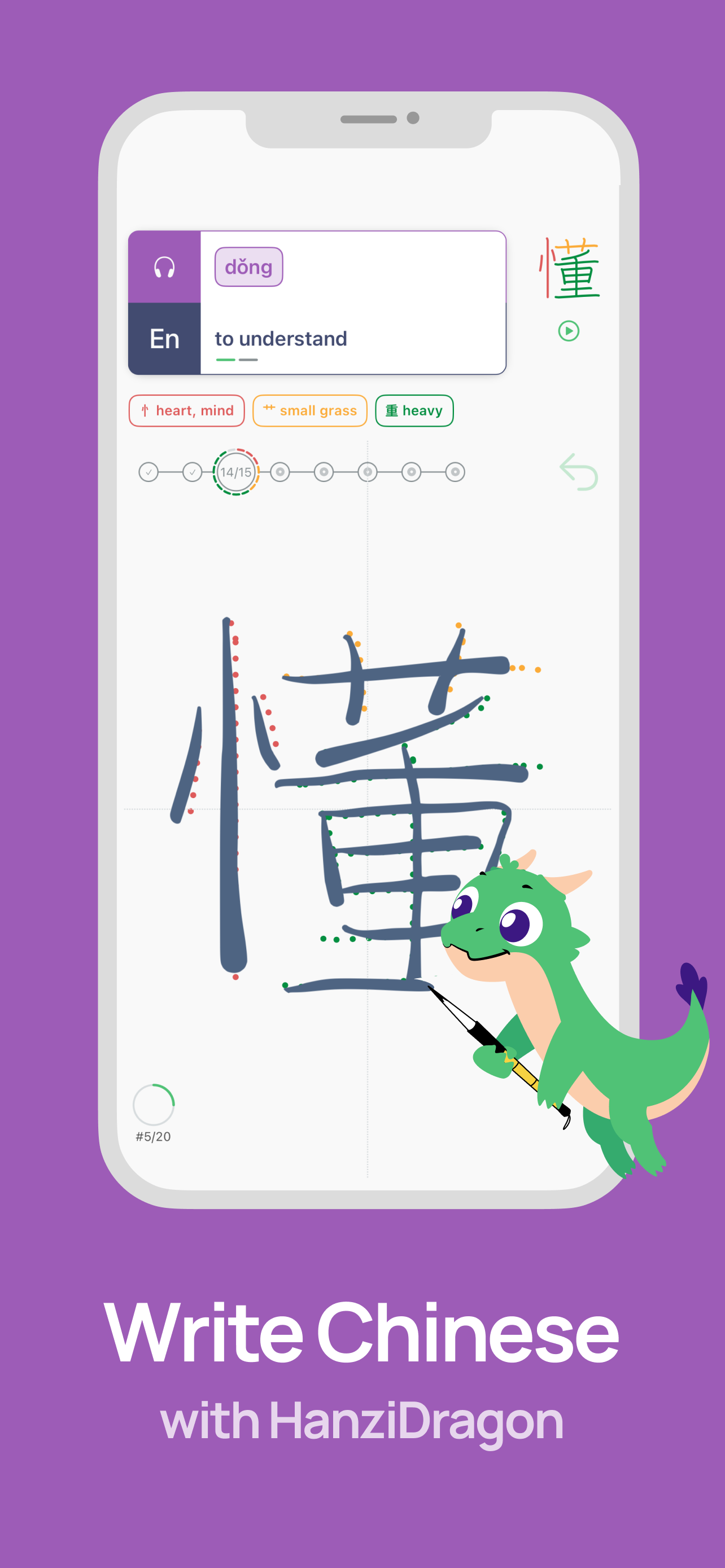
Practice characters with custom handwritten input and a natural calligraphic brush feel.

Learn in small steps

New information is introduced gradually: reading and meaning, stroke order, radicals, then writing.

Human-recorded audio

Readings are voiced by a native Chinese speaker to support accurate pronunciation.

What makes HanziDragon different

Recognition runs on your device

Your handwriting is read entirely on your iPhone or iPad: no cloud, no account, works offline.

It catches look-alike mistakes

When you confuse similar radicals — 日 and 月, 木 and 本 — HanziDragon points it out, instead of just marking the character wrong.

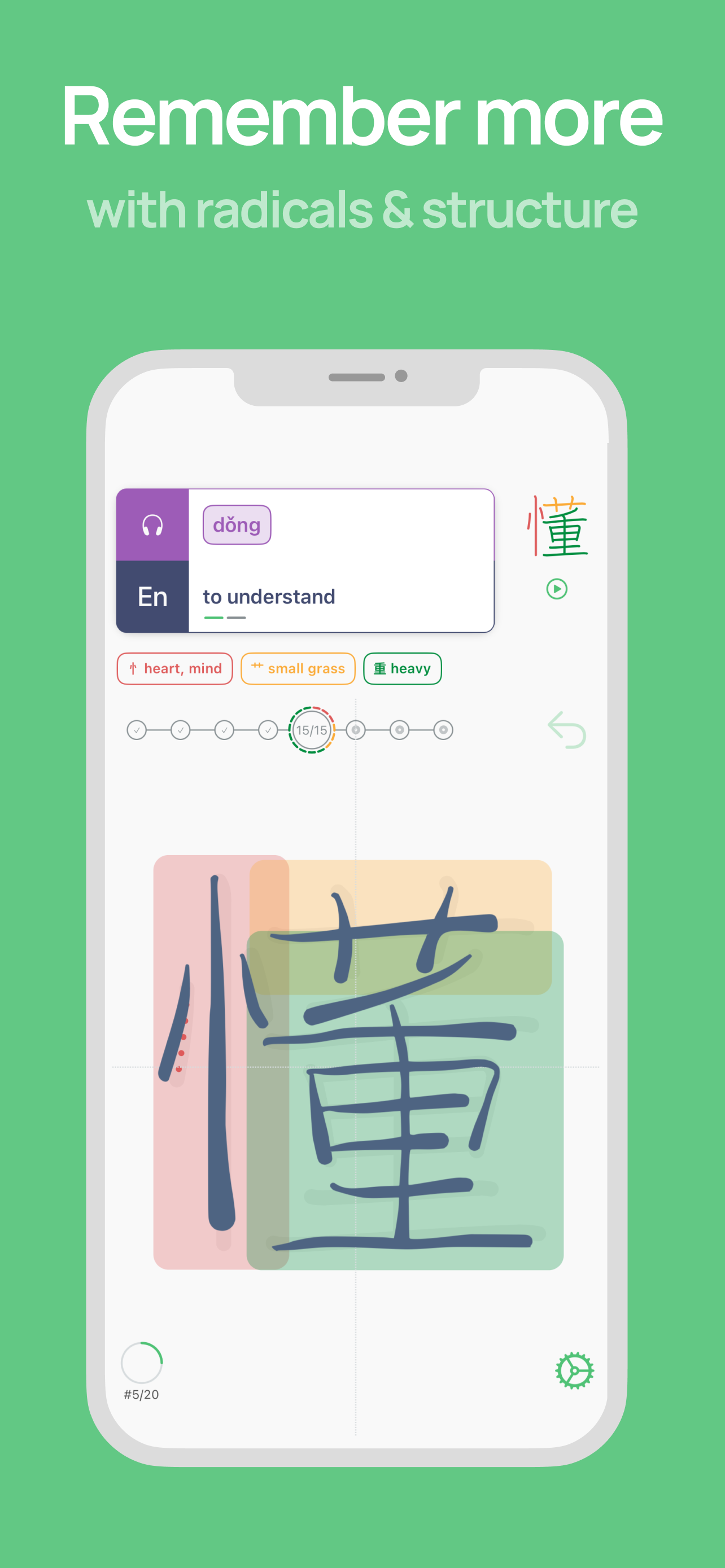
Radicals shown in color

Each radical gets its own color in the stroke-order animation, so the structure of a character becomes visible — not memorized blindly.

One layer at a time

Meaning, strokes, radicals, then words. Introduced gradually, the way the brain actually absorbs new information. No cognitive overload.

Two ways to practice

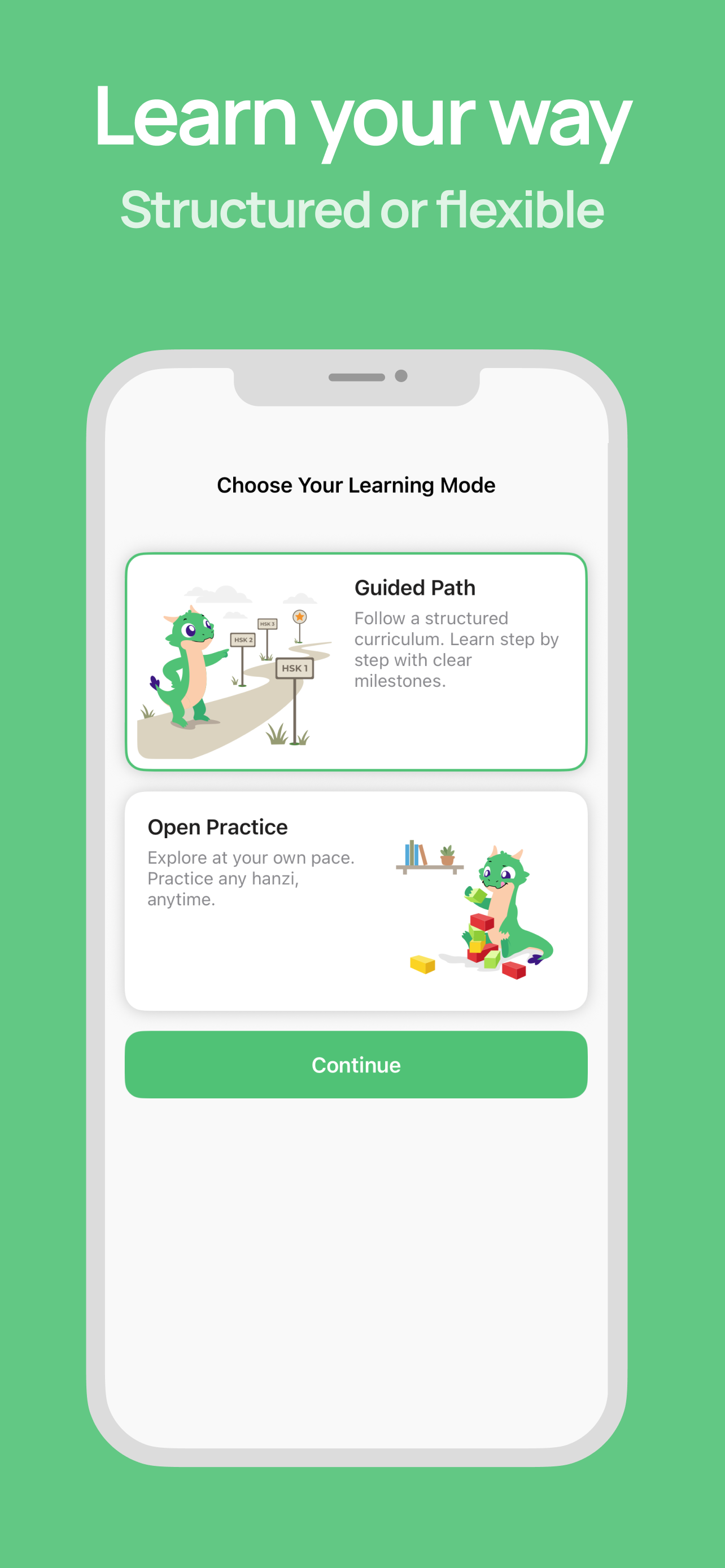
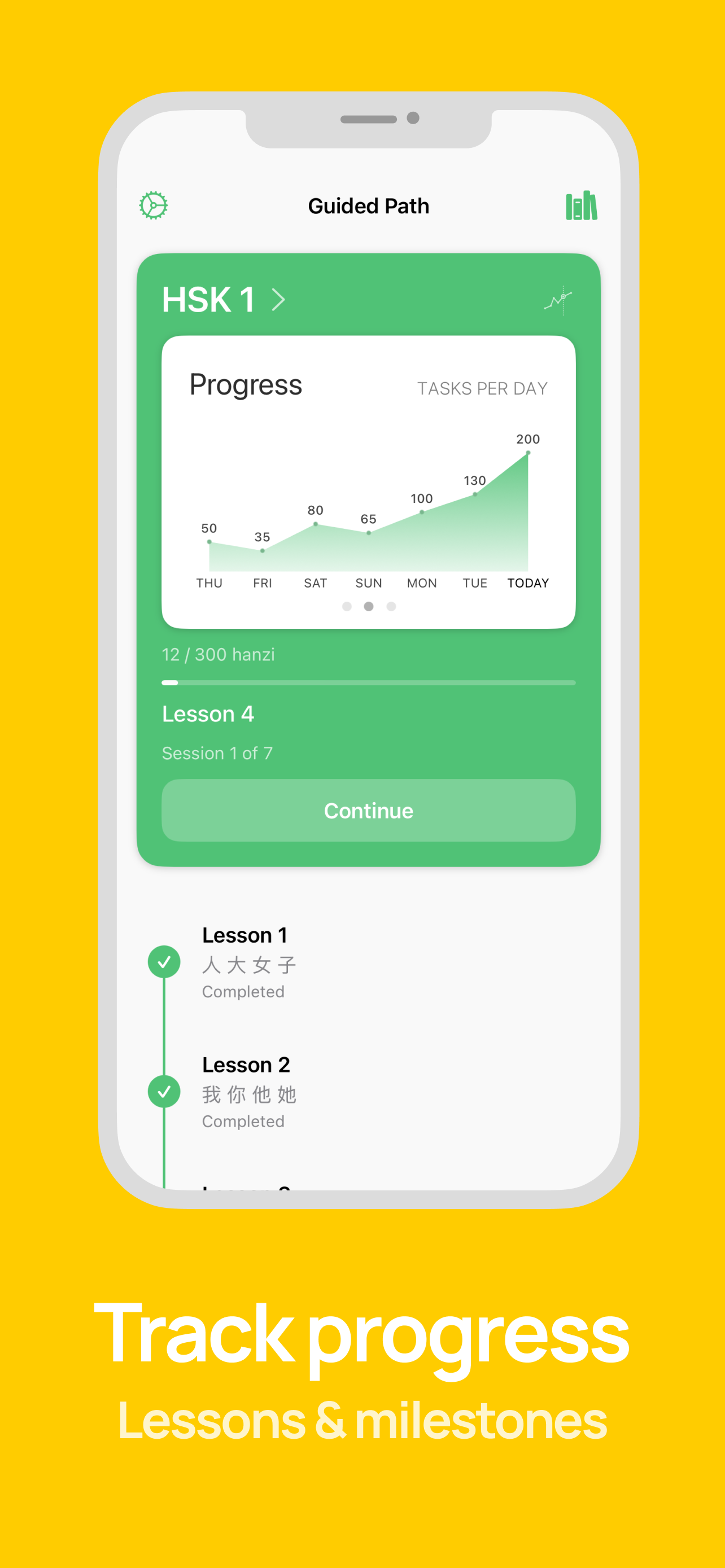
Guided Path walks you through characters lesson by lesson. Open Practice lets you pick your own characters, exercise types, and pace.

Built on a proven engine

From the makers of Robokana, our Japanese kanji app. The same writing engine, refined over years and adapted for Chinese.

How HanziDragon helps

  • Introduces hanzi gradually instead of overwhelming you all at once
  • Teaches stroke order and structure through guided writing
  • Uses radicals and components to improve memory
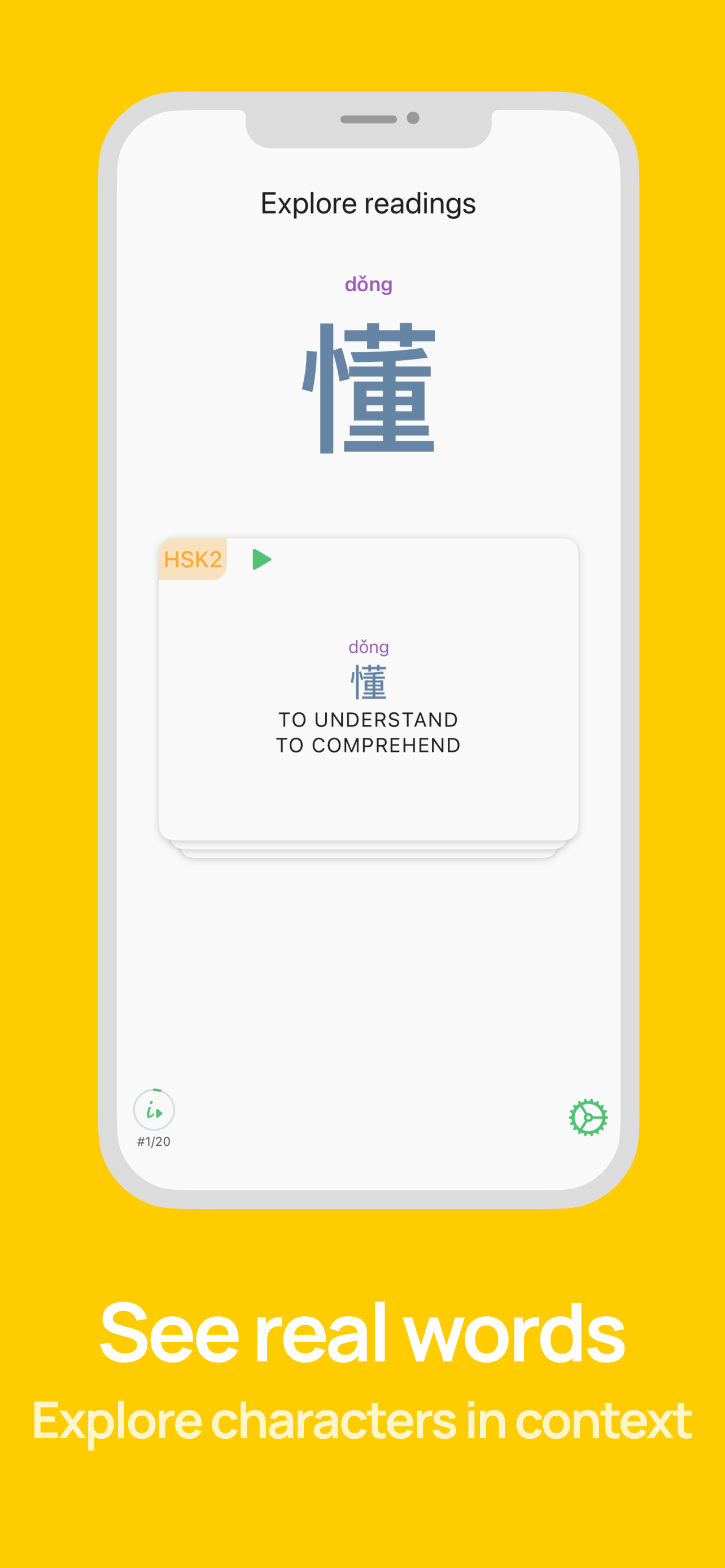
  • Reinforces readings, meanings, and compound words through focused tasks
  • Lets you learn at your own pace

Built for focused practice

Even a short session moves you forward. No streaks, no points, no artificial pressure. Practice when it fits your day. Progress syncs between iPhone and iPad automatically, so your session continues wherever you are.

Free to download · No account required · Works offline

HanziDragon vs Skritter

Skritter is one of the most respected handwriting apps for learning Chinese. It has helped thousands of learners build strong writing skills through years of refinement, an extensive content library and a rigorous handwriting practice system.

HanziDragon shares the same goal — helping people learn to write Chinese — but takes a different pedagogical approach.

While Skritter focuses on continuous handwriting practice supported by spaced repetition, HanziDragon invests more into the very first encounter with each new character: gradually removing guidance, teaching internal structure, and building a durable mental representation before the character enters long-term review.

HanziDragon Skritter
Overview Handwriting-first Chinese learning app that combines a structured HSK curriculum with a flexible Open Practice mode. Designed to help learners understand, remember and confidently write Chinese characters. One of the best-known handwriting apps for Chinese. Offers a mature learning system, a huge content library and years of refinement. Excellent for learners who want flexible handwriting practice across many different topics.
Pricing Free download, no account required. 120 characters available for free (10 lessons per HSK level). Premium: $4.99 / month or $29.99 / year. One subscription covers all your iOS devices and supports Family Sharing. Free download with Guest mode. Subscription required for the full experience (approx. $14.99 / month or $99 / year, depending on region and plan).
Platforms iPhone and iPad. iPhone, iPad and Android.
Learning modes Guided Path follows a structured HSK 3.0 curriculum. Open Practice lets learners freely choose characters or custom groups and study in any order. Flexible learning built around curated lists, textbooks, custom lists and spaced repetition.
Content Official HSK 3.0 Levels 1–3 with 950+ characters, compound words, native audio and a small collection of bonus characters beyond HSK. Extensive library of Chinese characters, vocabulary, textbooks and curated study lists covering far beyond HSK.
New characters Every new character goes through a carefully designed sequence that gradually removes guidance: full animation → guided stroke-by-stroke writing → component animation → stroke traces → spatial component model → independent writing. After handwriting practice, the character is introduced in compound words with native audio. Characters are introduced stroke by stroke. Learners reproduce each stroke while watching the demonstration before the character enters regular review.
Character structure Strong emphasis on decomposition. Characters are broken into reusable components that are color-coded consistently throughout the course, helping learners recognize recurring building blocks instead of memorizing each character in isolation. Components are present but play a smaller role. The primary focus is learning complete characters through repeated handwriting practice.
Stroke order Uses a forgiving approach. Small variations inside the same component are intentionally accepted. Component order, stroke direction and overall writing structure are evaluated more carefully. The goal is developing handwriting habits that transfer to real-world writing. Canonical stroke order is enforced strictly. Incorrect strokes are rejected immediately, encouraging precise reproduction of the standard writing order.
Writing feedback Learners complete the entire character first. Stroke count, stroke order and stroke direction are reported in words. Component sequence is not stated explicitly — it is represented visually through a side-by-side stroke-by-stroke animation of both the reference and the actual writing, with strokes color-coded by the component they belong to. For many characters, confusion between visually similar radicals is also detected. Feedback is immediate. Incorrect strokes are rejected as they are written, allowing learners to correct mistakes stroke by stroke.
Offline Fully functional offline after download, including handwriting recognition, writing feedback, curriculum, audio and character data. Supports offline study for downloaded content, while cloud synchronization and account-based features remain an important part of the experience.
Best for Learners looking for a structured path into Chinese writing, explicit explanations of character structure and gradual guidance while developing independent handwriting skills. Learners who want maximum content flexibility, extensive study lists and rigorous stroke-by-stroke handwriting practice over the long term.

Frequently asked questions

Who is HanziDragon for?

HanziDragon is designed for learners who are at the beginning of their Chinese journey but already have a basic understanding of the writing system.

If you can read pinyin and know the fundamentals of Chinese pronunciation, HanziDragon will help you learn to write and remember Chinese characters more effectively.

Which Chinese does HanziDragon teach?

HanziDragon teaches Simplified Chinese based on the official HSK 3.0 standard.

How many characters are included?

HanziDragon currently teaches 950+ characters, covering HSK Levels 1–3 plus a small number of additional high-frequency characters. Each character also comes with compound words, native pronunciation and detailed writing guidance.

Is HanziDragon only for HSK students?

HanziDragon is designed for a broad audience.

The curriculum follows HSK because it provides a well-structured, widely recognised progression — but the app is equally useful for anyone who wants to learn to write Simplified Chinese, regardless of whether HSK is part of their goals.

Do I need an Apple Pencil?

No. You can practice with either your finger or an Apple Pencil. Both are fully supported.

Does HanziDragon teach stroke order?

Yes.

Every character is introduced with animated stroke order. As you become more confident, the app gradually removes visual guidance until you can write independently.

Why doesn't HanziDragon always reject incorrect stroke order?

Because writing naturally and writing perfectly are not always the same thing.

Minor variations in stroke order inside a single component rarely affect handwriting quality or legibility. HanziDragon focuses more on component structure, stroke direction and the overall construction of the character — skills that transfer well to everyday handwriting.

How accurate is the handwriting recognition?

Recognition is performed entirely on your device.

Like any automated recognition system, it is not perfect and cannot replace a teacher. However, it is designed to provide useful feedback during everyday practice and works well for learning on the go.

What kind of feedback does HanziDragon provide?

Depending on your writing, HanziDragon may point out:

  • incorrect stroke count
  • incorrect stroke direction
  • incorrect stroke order
  • confusion between visually similar components (for supported characters)

To help you understand what went wrong, the feedback screen also shows a side-by-side animation of your writing next to the reference, with strokes color-coded by the component they belong to. This makes it easier to see whether a stroke order problem was actually a component sequence issue.

Because recognition works with probabilities rather than certainties, all feedback is an inference — the most likely interpretation of what you wrote, not a guaranteed diagnosis.

Why does HanziDragon highlight character components?

Chinese characters are built from recurring building blocks.

Highlighting these components helps learners recognize familiar patterns instead of memorizing every character as a completely new drawing.

The decomposition used in HanziDragon is designed for learning rather than linguistic research. Whenever possible, it follows conventional character analysis. In a small number of cases, the breakdown is intentionally adapted to better reflect handwriting or to make the character easier to understand and remember.

The goal is not to present an academic analysis of character etymology, but to make characters easier to understand and remember.

Can I practice any characters I want?

Yes.

Besides the Guided Path, HanziDragon includes Open Practice, where you can freely choose individual characters or create your own custom groups.

Does HanziDragon include review sessions?

Yes.

As you progress through the Guided Path, previously learned characters regularly return in Smart Review sessions to help reinforce long-term memory.

In Open Practice, you decide yourself what to practice.

Do I need to practice handwriting if I already use flashcards?

Not instead — in addition.

Flashcards build recognition: you see a character and recall its meaning or reading. Handwriting builds production: you reconstruct the character from memory, stroke by stroke. These are different aspects of memory, and they do not always develop together.

Many learners who can recognize a character in a sentence discover they cannot write it when the paper is blank. HanziDragon is designed for that gap — not as a replacement for recognition practice, but as a way to develop the skill that recognition alone does not train.

Does HanziDragon work offline?

Yes.

Once downloaded, all lessons, handwriting recognition, writing feedback, character data and audio work completely offline. No internet connection is required for everyday learning.

Do I need to create an account?

No.

Everything works immediately after installation. If you purchase Premium, your subscription is managed through your Apple ID and can also be shared with your family using Apple's Family Sharing.

Which devices are supported?

HanziDragon is available for iPhone and iPad running iOS 17 or later.

I already use Skritter. Why would I try HanziDragon?

Both apps focus on handwriting, but they emphasize different aspects of learning.

Skritter excels at flexible handwriting practice across a huge content library.

HanziDragon invests much more into the first encounter with every new character, using gradual guidance, component-based learning and detailed writing feedback to help learners build a lasting mental model before moving on to long-term review.

Why only HSK Levels 1–3?

HanziDragon is still a young project developed by a single independent developer.

The current focus is on making the first three HSK levels as polished and enjoyable as possible before expanding to more advanced content.

New characters and learning materials will continue to be added over time.

Why is HanziDragon only available on iOS?

HanziDragon is developed by an independent iOS developer and is currently focused on delivering the best possible experience on Apple devices.

Android support may be considered in the future, but there are no announcements to make at this time.